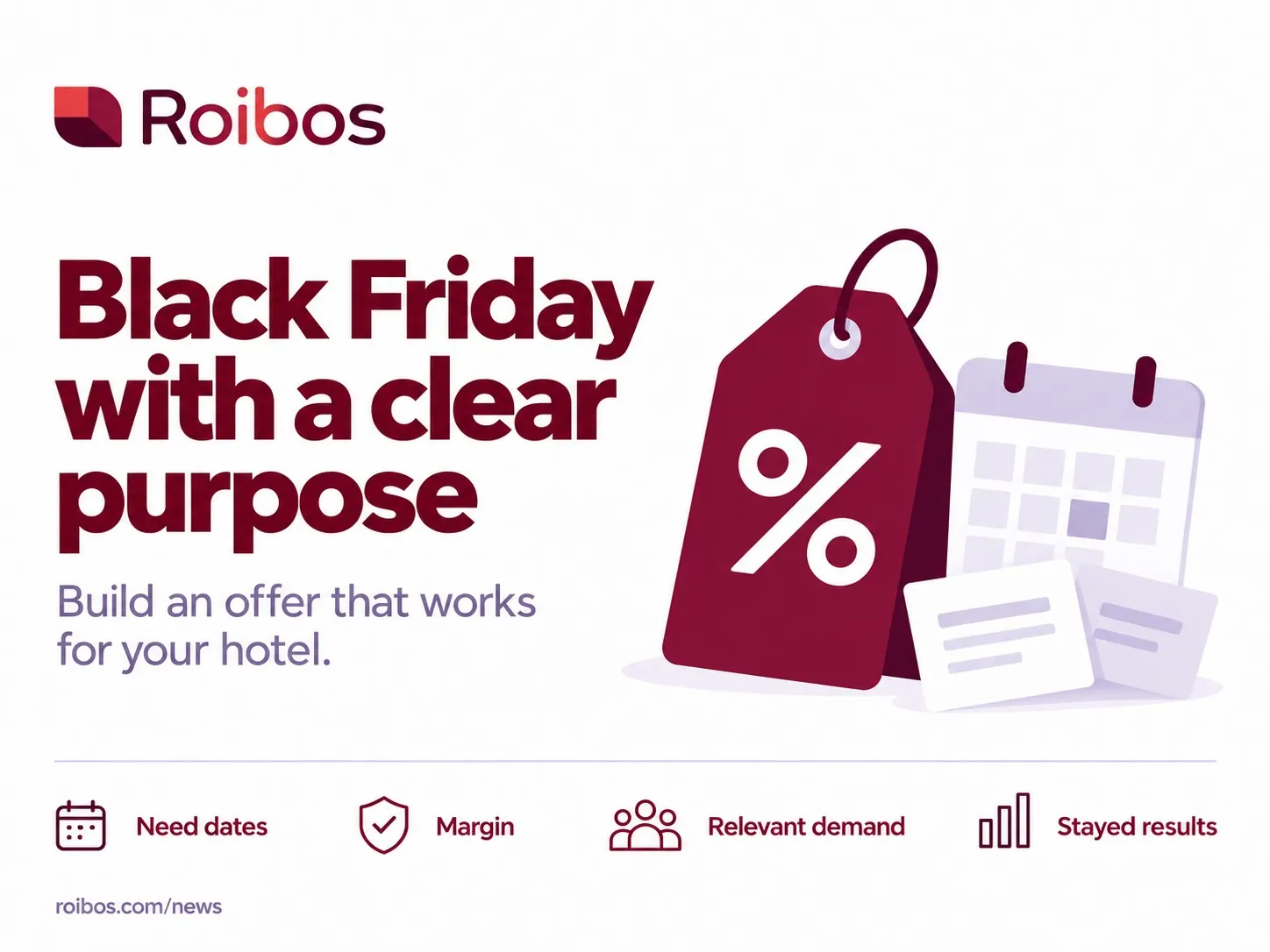
A Black Friday offer can generate bookings and still leave a hotel with a disappointing result. The question is whether the promotion brings business the property needs, at a price that makes commercial sense. Start there before choosing a discount or designing an email.
A useful Black Friday hotel strategy connects the booking incentive to a specific demand gap. It also gives distribution partners enough clarity to sell the offer accurately, without turning a short campaign into a long operational headache.
Start with the nights you need to sell
Review your forecast by arrival date, room category and length of stay. Identify where additional demand would be valuable, rather than applying the same promotion across the entire calendar.
A city hotel might prioritise selected weekends. A resort might focus on a quieter period between seasonal peaks. These are planning examples, not universal recommendations: local demand, operating costs and the existing booking position should determine the decision.
Keep the objective specific enough to evaluate later. Filling a weak arrival date and attracting a new source market are different goals, and they may call for different offers.
Work backwards from a sustainable return
Calculate what remains after the discount, distribution costs and the variable cost of delivering the stay. Consider any included benefits as well. A complimentary service still has an operational cost, even when its perceived value is higher.
For illustration, reducing a room rate from 150 to 120 currency units removes 30 units of revenue before other costs change. More reservations do not automatically recover that difference. Assess whether the offer is likely to add business or mainly replace bookings that would have arrived anyway.
Where suitable, test a package or a targeted benefit alongside a price reduction. Compare the commercial outcome rather than assuming one format always performs better.
Make the offer straightforward to distribute
Booking dates, stay dates, eligible rooms and cancellation terms should tell one consistent story. Check that the offer displayed to partners matches what the hotel intends to sell.
Give commercial teams a short explanation of the target guest and the reason to book. A clear proposition helps an agency assess relevance more quickly than a percentage presented without context.
Before launch, verify sample searches across eligible and excluded dates. Include different occupancies and room types. Ask someone outside the campaign team to explain the conditions back to you; ambiguity often becomes visible in that conversation.
Match distribution to the objective
Choose partners whose customers and selling patterns fit the inventory you want to move. A large network is useful only when the offer reaches relevant demand.
Agree how performance will be reviewed and who can resolve questions during the campaign. Keep revenue, reservations and distribution teams aligned so changes to availability or restrictions do not leave outdated messages in circulation.
Review after guests have stayed
Track booking pace during the promotion, then revisit the result after cancellations and completed stays are known. Compare realised room revenue, distribution costs, length of stay and the dates actually filled.
Use comparable periods carefully, accounting for changes in events and underlying demand. Treat the findings as evidence for the next campaign, rather than proof that every additional booking came from the promotion.
Before launching, write down one commercial objective and the measure that will show whether you achieved it. That simple decision gives every discount a purpose.